Showing posts with label Ancestry. Show all posts

Tuesday, January 29, 2019

52 Ancestors 2019: Week 4. "I'd like to meet the Brumbeloes"

Who, having done research on their family can pick just one ancestor to meet?  For me, I would have to say the best I can do is to narrow it down to a family unit.  There is a particular family in my tree for whom I have a fascination: the Brumbeloes.  This family lived through the Civil War, Reconstruction, abandonment, prostitution and murder.  Each family member has a fascinating story to tell. 

I credit the strength of the Brumbeloe/Brumbelow family with their mother, Martha Wilson Brumbeloe.  Throughout the decades, Martha can be seen living with her children, petitioning courts for restitution and doing all she can to keep her family together.  Her strength and example was passed on to her children as they faced their own trials and tribulations.

The daughter of James Wilson and Nancy Ann Ritter,  Martha Wilson was born 14 March 1816 in Upson County, Georgia.  She married Emanuel Joseph Brumbeloe/Brumbelow on 24 May 1835 and together they had seven children:  Camelius (1835-1900), Amanda Melvina (1838-1914), Lydia Louisa (1842 -?), William A. "Major" (1844-1862), Joseph H. (1846-1921), Georgia Ann (1855-1900) and Leanna (1856-1936).  Small bits and pieces of their lives have surfaced through court and military records, school and census records, and remnants of local newspaper articles.  Here is their story.

Martha was born and raised in Upson County, Georgia.  How she met her husband E.J. (as he is referred to in most documents) is not known.  Emanuel Joseph Brumbeloe was born in North Carolina in 1808, and moved with his family to Upson County around 1813.  As he was merely 5 years old at the time, it is possible that the Wilson and Brumebloe families were acquainted, but how E.J. and Martha met and courted is unknown.  At any rate, they meet and married when E.J. was 27 and Martha was 19 years old.

Between the years of 1838 and 1856, Martha and E.J. produced seven children.   For the most part, all the children received an education, if not somewhat intermittently.  As they are listed in the Poor School records for the county (see usgwarchives.net/ga/upson/history), it is supposed they struggled financially.  And then the war hit.

We lose site of E.J. in 1857.  There are no muster records for him.  There is no death certificate. He simply disappears.  The eldest son, Camelius, steps up to support the family.  Camelius aids the Confederate cause by remaining at home and working his pottery business. He supplies the military with various clay items needed for the war, including spittoons.  Correspondence between Camelius and his commanders can be seen on the website Fold3.  We know he is a bit of a rascal as a court document survives charging him with "playing and betting at cards." (Georgia, Upson County, Judge of the Superior Courts of the Flint Circuit, 11th June 1859.)
All that remains of JugTown in Upson County where Camelius made pottery for the Confederate Army.
Second son, William A. "Major," went off to war.  Sadly, it isn't long before he is killed in action at the Battle of McDowell in Highland, Virginia. He was just 18 years old.  I wonder at Major's influence over his younger brother, Joseph.  I think that perhaps Joseph wanted to be like his elder brother, so he lies about his age and follows Major in joining the Confederate Army.  Joseph is only 15 years old when he witnesses the horrors of war on the battlefield. His military records indicate that he is released from his duties and sent home "due to extreme youth."  This discharge happens just weeks after his brother's death. 

Joseph returns home and family lore states that he was known as the town drunk.  He never married and never had any children.  I can only imagine that he suffered greatly from what today we call PTSD.  I visited the battle site in Highland, Virginia.  Today it is quite serene.  It is hard to envision the brutal sight that these boys witnessed.  My heart softens when I see in records that throughout the remainder of Joseph's life, his siblings kept him close in their homes and cared for him.

Joseph H. Brumbeloe.
The war also affected the Brumbeloe girls.  Amanda Melvina, my 3rd great grandmother, married Ulysses J. Daniel.  Their time together was short lived.  While their union produced two children, Louisa and Chesley, Ulysses disappears in the 1860s and is never heard from again.  Amanda presses forward as a single mother trying to survive and raise her children during very uncertain times.

Lydia Louisa (for whom my 2nd great grandmother is named) is listed as a prostitute in the 1860 census.  At the age of 16, Lydia married Burwell Mack Denson, and after becoming pregnant with their son, was abandoned by her husband.  Records indicate that the two divorced just a year after the marriage took place. Who knows?  Perhaps it was a shotgun marriage and he abandoned her shortly thereafter.  Needless to say, we have another Brumbeloe mother left to struggle on her own.  Brother Camelius steps in and takes in not only his sister Lydia and her baby, but also Lydia's sister in law and children who also are now fatherless. 

The 1860 census shows the occupation of "Prostitute" for both Lydia and her sister in law, Maranda H. Denson.  To me this occupation listing in the census appeared to be both bold and disturbing.  Could this really be considered an occupation acceptable to place in a census record?  Further research showed me that not only was it acceptable, but it was common.  Women did what they had to in order to feed their children.

Little is known at this time about Martha and E.J.'s daughter Georgia Ann Brumbeloe.  Born in 1855, she is found enumerated with her mother, Martha until the 1880 census where she can be seen living with local doctor Benjamin Franklin Newsome.  There is quite a bit of controversy surrounding Dr. Benjamin F. Newsome and his brother, Dr. George W. Newsome.  The brothers are known to have fathered a number of children in the local area.  Over the years, a few of the Brumbeloe daughters can be seen living with one of the doctors and claiming the occupation of  "housekeeper." Amanda lived with Dr George Newsome as his housekeeper in 1900, and Lydia Brumebloe Denson had two illegitmate sons with Dr. Benjamin Franklin Newsome.  We don't know what Georgia Ann's connection with Dr. B.F. Newsome might have been.  The 1880 census merely states that she is "at home."

George W. Newsome, MD
Finally, we have Leanna Brumbeloe.  Leanna was born in 1856 and at the age of 16 married John R Duckworth.  Their union produced two children, but the marriage was a tumultuous one.  In 1880, Duckworth was murdered during an argument regarding his wife and a relationship with another man, Dubose Humphries.  The newspaper articles covering the event implies that based on comments made by Duckworth there may have been an affair between Humphries and Leanna.  Duckworth was under the assumption that the two were planning to run away together.  No further article or evidence shows that this was intended, and Leanna and Humphries never joined together after the Duckworth's death.  Leanna never remarries. She becomes another Brumbeloe mother raising two children on her own.

This family's strength and resolve to get through hard times is an inspiration. Given the opportunity I would love to sit down with them as a family and hear about their experiences from their point of view.  Where did the fathers disappear to?  What were the Newsome doctors to this family?  Were these women manipulated and controlled in return for sustenance to survive poverty and destitution?  The loss of a son in the war and the horrific psychological impact it had on another, affected not only Martha but the rest of her children who stuck by one another through thick and thin.

How did these events affect the way the each of these daughters raised their children?  Amanda Brumbeloe was the great grandmother of my own grandmother.  One thing my grandmother use to say to all of us granddaughters was "You don't need a man to survive.  Get an education and be prepared to take care of yourself."  Is this something passed on to her from Amanda, and then Louisa, on down?

The individual stories and experiences woven together make the tapestry that is the Brumbeloe family story.  No, there is not one ancestor I would like to meet, there is a whole family!

52 Ancestors 2019. Week 3: Unusual Name - Ruhamah

Everyone has an ancestor with an unusual name, but when you are from the South.... where do you begin?!  My ancestors found it natural to name their children after ranks in the military.  Commodore Lackey. General Wilson.  Major Brumbeloe.  Seriously, these are their names!  You think searching ancestors named John Smith brings up too many searches, try entering General Wilson and see how many hits you get on actual Generals and not people with that forename! It's crazy.

I've already written about my great grandmother whose name is Ollie Ossilean Posey.  That name is unusual, but since I've already spotlighted her, I've decided to cross over to my husband's ancestry (in this particular instance, also in the South).  Ruhamah.

 Ruhamah was born in 1822 in West Virginia and died some time before 1900.  We don't have a maiden name for her, but in the 1880 U.S. Federal Census she is listed as Ruhamah Dent, the mother in law for the Lafayette Shiflett family.  Lafayette Shiflett and his wife Nancy Louthry are my husband's 2nd great grandparents.  Their son, Parker, is my mother in law's grandfather.  These are names we have known and have been documented for decades.  Ruhamah, however, was not known, and until the 1880 census was scanned and made available on line, she was a blank line on a pedigree chart.  (Thank you volunteers who scan images! And thank you to those who index those images!)

Armed with a last name for Ruhamah, we were able to search for further documentation.  What we have found is a marriage record.   On 1 October 1868, Ruhamah Laugherty married Jacob Deft in Randolph County, West Virginia.  Score!  We have a marriage, and we have a name she used before she was a Deft... but wait!  Her daughter's maiden name is Louthry.  That's awfully close to Laugherty, and since we know that oftentimes names can have various spellings based on who is doing the writing and who is pronouncing the name, it most likely is the same.  But Louthry or Laugherty, whichever way we want to move forward (and yes, we should always use a variety of spellings when researching), this can mean one of two things: either Ruhamah was married prior to Deft or her daughter Nancy was illegitimate.

If we go by her assumed birth year in the 1880 census, then in 1868, when Ruhamah married Jacob Deft, she was 42 years old.  Her daughter, Nancy, was 26 years old.  Nancy being born in 1854 would have Ruhamah being 32 years old.  So, this conceivably could mean that Louthry/Laugherty is from a previous marriage. 

In writing this blog post, I decided to do a new search on Ruhamah to see what more information I could find.  My search was not in vain.  In the 1860 census, we find Ruhamah's name transcribed as Ruamish on the census Index.  Looking at the actual record, I see the writing as Ruamiah Laugherty.  She is listed with her daughter Nancy C. (age 6) and son, Marion (age 3).  A son!  This is new!  This new lead will open up to further research on Ruhamah and her family.

But let's get back to her unusual name -- Ruhamah.  A search on Google lead me a baby naming site that states:  From Hebrew, meaning "the one who has been spared."  In the Bible, Hosea is told by God to name is daughter Lo-Ruhamah; later, God tells Hosea to call his daughter Ruhamah because she has been spared.  The name is commonly spelled without the final "h" in English, as well as in modern Israel."  www.babynamewizard.com

Ruhamah is such a lovely name! It is not one I have ever seen or heard before.  I have come across quite a few of these beautiful names while researching family history, that had I known of these names, my children might be going by something completely different today!  Then again... maybe it is best they have the names I did give them.  My own father, after having started his journey in family history, wanted to change my name to Hepzibah!  Hmmmm.... I think I will stick with Melyssa.

What unusual family names have you come across in your research? Have you passed those names on to your children?  Feel free to post in the comments.  I'd love to hear from you!

Monday, January 21, 2019

52 Ancestors 2019. Week Two: Challenge

I would say my biggest challenge at this point in my genealogical journey is archiving and sharing.  Let me explain.

In 2009, my parents tragically passed away.  Both of my parents were genealogists and well respected historians.  I was fortunate to inherit all of their research documents, photos, charts and books and articles they wrote.  In 2013, my grandfather passed away at the age of 97.  From him I inherited photos and letters dating back to the nineteen teens.  Fantastic! Right?  Yes, to an extent.  However, unless you live in a home that can serve as an active archival library, keeping and maintaining these treasures can be a challenge.

First, I tackled my parents' photos.  I scanned everything and began to place the images on Ancestry and FamilySearch where other relatives could enjoy them.  What good are they sitting in an album in a box in storage?  It was fun going down memory lane.  I saw photos of them with friends from back in the 1970s and thanks to Google and Facebook, was able to track some of those friends down and share the memories.  In return, I received countless stories about my folks that either were new to me or I had forgotten.  Hearing those stories was a blessing to me as I missed my parents intensely.

While at RootsTech2016, a gentleman who had heard I was at the conference tracked me down.  He was a follower of my father's work from when dad was Mayflower Historian General.  He heard my dad had passed away and inquired about the research my father had been doing on the Cooke family.  I had just seen some papers dad had on further research he was doing on the Cooke project and asked the gentleman if he would like them.  He was keen to receive them and I was happy to pass them along so that this man could continue the research where my father left off.

And then there were the photos and letters my granddad left.  The photos were easy enough.  Like I had done with my parents' pictures, I scanned and shared.  With all the photos I've inherited, I created Chatbooks and gave them as gifts to family members.  Now, what to do with the originals? I'm still working that out.  Some I have sent on to relatives and others I have placed in albums.  Some I have tossed.  I mean, who wants to hold onto albums of trips to Russia that has only pictures of places?  It wasn't my trip and they aren't my memories.  I asked around and no one wanted them.  You can't keep on to things just because your Granddad took the photo.  Still, it's hard to let go.

Now to the letters.  Treasures! I tell you that even the most mundane letters, when put together chronologically, tell a fascinating story.  My plan is to get all of the letters (and there are BOXES and BOXES of them!) put into an album, scan them into a publishing program and then transcribe them and have the book published with the transcriptions next to the letters.  Great!  Then what?  Where do we store these letters?  Offers to relatives come up empty.  My thought is to share them with the local historical society in the town where Granddaddy grew up.  I'm not ready to part with them today, but I won't always be around and I would hate for them to be tossed in some arbitrary clean up done after I'm deceased.

The saying is true: When a person dies, a library dies with them.  Sadly, the reality is we can't keep everything. We have to be discerning on what we hang on to. While the originals may never find a permanent home, the images will at least be there for posterity on Ancestry and FamilySearch.

Feel free to comment and share your ideas on how you have preserved and archived the items you have inherited.

Wednesday, January 2, 2019

52 Ancestors 2019 - Ancestor #1 Ollie Ossilean Posey

Ollie O. Wilson was born Ollie Ossilean Posey on 9 September 1892 in Reynolds, Taylor County, Georgia.  Her parents were Andrew Breckenridge Posey and Mary Julia Windham.  Ollie married Judson Chesterfield Wilson on 19 November 1905 when Ollie was just 13 years old.  Ollie and Judson had two daughters, Eleanor Katherine and Myrtice Lucille.  Ollie Ossilean Posey Wilson died on the 9th of August 1977.

Ollie Ossilean Posey Wilson was my mother’s grandmother.  I first heard her name spoken when I was just seven years old.  My mother had recently joined the Mormon church and her interest in genealogy was piqued during her conversion to Mormonism.  Mother began a regular correspondence with her grandmother asking questions about her life and growing up in Georgia.  Family history became a life long passion for my mother and she passed that passion on to me.

The first ancestor I ever learned about was my great grandmother Ollie.   Her name was so unusual that I often asked about her and how she got her name.  Ollie Ossilean seemed to be an unusual name.  No one, not even great grandmother, knew why she was given this name.  Over the years as I have researched the census records for Taylor County, Georgia, I have learned that Ollie was a common name for girls, but I have yet to learn where the name Ossilean derives or why her mother, Julia, chose it.

I met Ollie in 1975 when I was around 8 years old.  My parents piled my brother and me into our car (without A/C) and we made the long trek during the hot summer from Denver, Colorado to Georgia.  I remember that trip well.  One does not forget endless car rides with no air conditioning!  Besides the heat and very few rest stops along the way, the trip was made memorable by our visit with Ollie.  She was a frail woman, small in height and weight, and had a very deep Southern accent.

My mother brought a tape recorder and conducted a thorough interview with Ollie.  I have this cassette tape today.  I am glad I had the foresight in the early 1990s to transcribe the interview and later convert the tape to CD.  Both my mother and great grandmother have since passed away and to hear their voices again brings tender emotions.  What it also brings is information over looked.  I have read the transcript numerous times, but it isn’t until you know the question you want to ask that you begin to look for the answer.

During our visit with Great Grandmother we were introduced to a man my mother as a child had called “Uncle Jay Bird.”  I was told he wasn’t in fact an Uncle.  In the South, family friends are often referred to as Aunt and Uncle.  Older cousins can sometimes be referred to as such, as well.  But back to the interview.  I was curious as to who this “Uncle Jay Bird” really might be.  How close of a friend was he or was there in fact a genetic relationship?  Reviewing the transcript, I found that Ollie revealed his name, Edwin Hill, as well as that of his brother, Bernice (yes, a brother!) who had recently passed away.  This clue was what I needed to further research Uncle Jay Bird.  In the interview, Ollie tells of Uncle Jay Bird being terribly abused by his step mother when he was growing up, and often Ollie would feed him and let him hide in the tree in her yard.

In the 1940 U.S. Federal Census, Edwin Hill is found living with my Great Grandparents and their two daughters (one being my grandmother Katherine).  This confirms the name she has given for Uncle Jay Bird, and if they were, in fact, as close as she claims, it isn’t surprising to find him living with my great grandparents during this census.  But then something else happened…  Ancestry DNA.

Several years ago, I took the Ancestry DNA test.  Those who have tested with Ancestry will tell you, you can go quite some time before you get a match that catches your attention.  Recently, I received a third cousin match with a grandchild of Bernice Hill, the brother of Uncle Jay Bird.  Shock and surprise! And yet, maybe not so much.  Reynolds, Georgia is a tiny town.  Cotton farms surround the area and little else.  The population there was small back in the day and even smaller now.  Many of the people living there are related to each other in one way or another.  But how is it that Uncle Jay Bird is related to me?

Doing a side by side generation comparison of Bernice’s grandchild back to Bernice’s parents, and giving allowance that due to some age gaps being greater than others, it appears that Bernice and Uncle Jay Bird may be my great grandfather Judson’s half brothers.  In most any other circumstance, I would be able to sort this out except for one small matter… Judson’s dad.  Judson’s father was known as General Wilson.  No, not A general.  That’s his name.  Try searching that name just after the Civil War era!  What’s more, General Wilson died at the age of 27 when Judson was just a few weeks old.  We have no parentage for General Wilson.  He is our Brick Wall.  One my mother spent her adult life trying to tear down.

And then there are the dates that put everything into a muddle.  Judson was born 1880.  Uncle Jay Bird was born in 1903.  Even if Judson had fathered Edwin Hill, that would not give us a genetic match for Bernice.  General Wilson died in 1880, so he cannot be the father of the Hill boys.  But what about Judson’s mother Louisa Brumbeloe Wilson?  Well, that is the next journey I am embarking on.

If Great Grandmother Ollie had not introduced me to Uncle Jay Bird, and had not given us his real name,  I would never have questioned his relationship to my family nor given much notice to his brother’s descendants who matched me in Ancestry DNA.  I feel as though Ollie is reaching out from beyond and trying to help me in solving this mystery.  Her clues have been great so far.  I hope to come across more as time goes on.

Great Grandmother Ollie was married when she was just 13 years old.  She lost 9 children before she carried my grandmother full term.  She had a big heart and the stories I have heard of her helping strangers in need are indeed a testament to her upbringing and giving nature.  She is my first ancestor I have researched and the first and only ancestor I had the good fortune to meet in life.  It seems fitting that I chose her to be the first ancestor for my 52 Ancestors in 52 weeks challenge.  Keep the clues coming Ollie!  We will solve the Uncle Jay Bird mystery yet, and perhaps along the way, tear down a long standing brick wall!

Tuesday, April 26, 2016

The Best of the Golden Age of Genealogy: Top Posts of April


 In case you missed it, here are the top three viewed posts of my blog in April.

Wait! What?!! What To Do When An Unexpected DNA Match Happens

Have you submitted DNA and found a close match of a relative you know nothing about?  It happens!  Take a look at this blog entry and share your story in the comments.


When You're Adopted, Which Ancestors Do You Choose?

I often hear from friends that they are uncertain as to which family line they should research.  When you are adopted, this is a question you might ask yourself.  I have shared my story here and would love to hear how you have dealt with adoption in your research.


BillionGraves Takes The Anxiety Out Of Searching For Loved Ones

A recent trip to Quantico National Cemetery gave me the opportunity to share the magic of BillionGraves.  When we visit our loved ones who have passed on, we want to spend time at their burial site and not wandering around aimlessly.  Has BillionGraves helped you locate ancestors?


If you are enjoying The Golden Age of Genealogy, please like and share with your friends on Facebook, Twitter and GooglePlus.  To avoid missing future blog posts, remember to follow me by entering your email on this blogsite! 

Monday, April 25, 2016

Gettysburg Retreat

This past weekend was the first chance I've had this year to get away.  I say "get away," but to be honest it was an excuse to get out and do what I enjoy most -- immerse myself in history and graveyards.   It was a gorgeous weekend with low humidity and a lot of sunshine, and so I headed off to Gettysburg where I could escape into the past and reconnect with my ancestors.


My roots are planted deep in Civil War history. I personally live just off a well known battlefield in Virginia, but it goes much deeper than that.  My ancestors fought for both the North and the South in what my mother called the "War of Northern Aggression," and my dad referred to as the "Great Rebellion."  Dinner conversation during my childhood was interesting to say the least.

There was a time when I was deep into the research of my ancestors' experiences in the Civil War.  My dad's Grandfather (yes, we have very long generations on his side of the family), fought with Company M, Massachusetts, 4th Calvary Regiment.  My mother's 2nd Great Grandfather fought with Company G, North Carolina 38th Infantry Regiment.  Obviously they both survived, because I am here to write about it, but in doing their research I came to learn of the hardships they personally endured.  One grandfather, in particular, never recovered from his wounds of war and was unable to work.  The affects of the war on his body extended to the hardship on his family who struggled to break free from government assistance for another generation.


It can be overwhelming touring a place with such a great history.  Absorbing the information can be compared to drinking from a firehose -- definitely information overload.  I chose to do a self guided tour of the battlefield. Gettysburg has been greatly preserved and I have to say, the audio tour was of great benefit to me.  Since I knew the Regiments of a few of my ancestors, I was able to follow the detailed map to the areas in which their troops would have set up camp, as well where they marched directly into battle.

Walking where they marched and trying to envision what they experienced was quite a sacred experience for me.  Here we were as visitors, enjoying a gorgeous weekend, embracing the beauty of the landscape, escaping our crazy busy lives at the very location our ancestors came to lay down theirs for our freedom.  It was humbling to say the least.

The battlefield today is peaceful and beautiful, and people come from around the world to study and remember the events that took place there.  But just off the battlefield is another location that I took the time visit: the cemetery.  Like the battlefield, it too has been maintained and tourists walked the pathways and talked in hush voices. 


 I spend a good deal of my free time photographing cemeteries for record preservation. While there are thousands of headstones in the Gettysburg National Cemetery, none of them, to my knowledge, are my forefathers (and not all are of Civil War era). They are somebody's ancestors though, so I took some time to digitize as many headstones as I could before having to leave for the day.  Later, as I began transcribing the information from these graves, it touched me to see that matches were being made with entries in FamilySearch.  It is my hope that the images I took this weekend make it to those individuals who have been searching and searching for their ancestor's information.

It was a wonderful retreat.  I could easily have spent a week in Gettysburg and still not done all the things I would have like to have done.  If you get a chance to visit any location of your ancestors, I suggest you take with you notes about their lives and time spent there.  It really makes the visit meaningful and brings it to a very personal level.

I appreciate the time you spent reading my blog.  I hope that you will "like" and "share" it with your followers on Social Media.  You can find the share links just below this posting.  I love to hear from my readers, so if you would like to leave a comment, I would love to hear from you!


Sunday, April 17, 2016

BillionGraves Contest Leads to Free Canary Islands Vacation

In the Summer of 2015, BillionGraves offered a Summer of More Get Away contest.  Combine my passion for cemeteries with a contest, and immediately my competitive nature emerged!  Over a couple of months, with the help of my family and friends, I managed to photograph 68,972 images, allowing me to win a trip to anywhere in the world.  My family and I chose to travel to Teneriffe, Canary Islands, Spain.

A Room With A View

Our initial set off was not without incident.  A delayed and then canceled flight out of Dulles Airport resulted in our luggage being lost somewhere between Washington and France, or maybe it was France and Spain.  We never did find out what happened.  Our first 3 days in Teneriffe was spent in the same travel clothes.  But, hey!  We were in the Canary Islands, so who cares, right?!
 
My 16 year old daughter carried all her luggage on the plane.  Not a care in the world!

My 19 year old son looks like he could live here!
While waiting for our luggage to be found, we decided to connect with members of our faith.  Meeting with members of the local LDS church was like seeing family and made the trip even more special than it already was.

The Church of Jesus Christ of Latter-Day Saints, Teneriffe, Canary Islands
The Sister Missionaries were as happy to see us as we were to see them!

Our luggage finally arrived and after some respite, we were ready to see the island.  The black sand beaches are a result of the volcanic eruptions from El Tiede.  It was strange to see beaches this dark, but they were so beautiful!


I was fascinated by the rock piling on this particular beach.

Even though this was to be our vacation, we couldn't resist visiting cemeteries around the island and photographing them for BillionGraves.  The visitors of the cemeteries greeted us with an embrace and love.  Although we could not communicate in their language, we could feel their warmth and welcome.
 

From our Condo, the drive around the island took about 3 hours.  It was amazing that at one moment we would be on the beach and within an hour we would be in the mountains.  The view was always amazing!


 Our trip to Teneriffe was definitely an experience of a lifetime.  With my children nearly grown, it was expected that this may be our last full family vacation.  I am so grateful for the kindness of BillionGraves and their willingness to send the four of us on such a spectacular trip to another country. It is something we will never forget!  Thank you, BillionGraves!

If you would like to learn more about volunteering in this effort to preserve cemetery records, visit BillionGraves.com.

Thank you for taking the time to read today's blog post.  If you enjoyed this article, please share with your followers by selecting one of the share buttons below.  I enjoy hearing from my readers and would love for you to leave a comment.  Thank you!


BillionGraves Takes The Anxiety Out Of Searching For Loved Ones


Yesterday, I had the privilege of taking my friend, Cathi, to Quantico National Cemetery to visit her father's grave.   Six years ago Cathi had moved to Arizona and has been unable to visit her father's grave regularly.  As you can imagine, the cemetery is rather large, and since it had been awhile since Cathi had come by, her memory needed to be jogged as to where the actual grave was located.  She knew the Section but could not remember where the actual plot was.

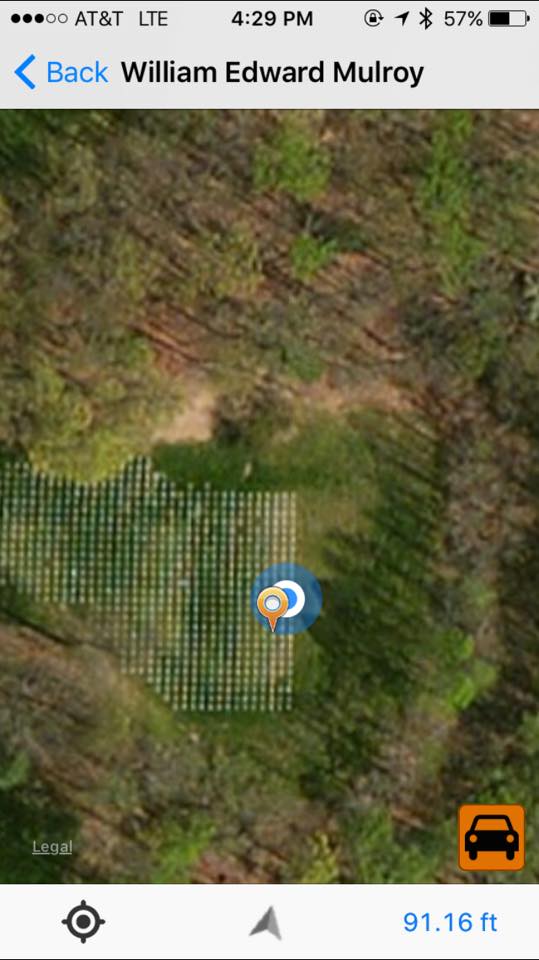
I have been working with BillionGraves for a number of years.  I knew that using BillionGraves' app, which provides the GPS location for every gravestone photographed, we would find Cathi's father in a matter of moments.  After opening the app, we entered her father's name, William E. Mulroy.  Immediately, the record of his burial showed up, and by simply tapping on the map icon, we were given the exact location of his headstone in relation to where we were standing.

Cathi was amazed that the BillionGraves app provided the exact location of where her dad was, as well as the headstone information.  When a relative, and in this case, daughter, wants to visit the resting place of a loved one, time would rather be spent visiting the grave than looking for it.  Since the cemetery information center was closed for the day, Cathi worried that her anxiety would increase as she tried to find her dad's grave.  BillionGraves removed the anxiety and afforded her the opportunity to spend more time with her dad and memories.


BillionGraves is a worldwide grassroots program that allows for anyone researching their ancestors to find the cemetery and gravesite of their loved ones who have passed away.  The site is free to join and anyone can be a BillionGraves volunteer.  It is a simple process that will have you helping people around the world as fast as it takes to snap a photo.

There are several ways to volunteer with BillionGraves, the top two being photographing and transcribing.  To photograph headstones, simply grab your smart phone or ipad and download the BillionGraves app.  When you arrive to the cemetery of your choice, open the app and click on the camera icon.  You will see the name of the cemetery appear in the camera with the live image.  As you walk grave by grave, simply take a picture of each headstone.  When you are done photographing, you may upload the pictures immediately or wait until you get home.


After you upload the pictures you have taken, you will want to transcribe the photos.  Log into BillionGraves on your computer and on the dashboard you will see a Photos icon.  When you select Photos, you will have the option to select the photos you have taken.  Each picture you click on will give you a form to complete with the information from the headstone.  Should you choose not to transcribe the images, the photos will go into the BillionGraves database for another volunteer to transcribe.

Volunteering for BillionGraves is a wonderful opportunity to give back to the genealogy community. There are millions of individuals, like Cathi, searching for the headstones of their loved ones. Whether the search is for family history purposes or to reminisce and pay respects, being able to access the gravesite immediately allows for time to be well spent.

For more information regarding BillionGraves, visit BillionGraves.com.

Thank you for taking the time to visit my blog.  If you enjoyed this article, please share by using the share icons provided below.  As always, I love to hear from my readers and welcome comments.  If you would like to be a regular follower of The Golden Age of Genealogy, please enter your email address in the side bar to the right of this article.

Sunday, April 10, 2016

Southern Comfort -- Food Memories of Days Gone By


Ever since I can remember there have been family dinners.  Family come to visit for holiday meals, such as Thanksgiving and Christmas.  Family gather together for births and deaths, and there is always food involved.  Graduations and other celebrations also bring family together, and with that gathering, there is again, always food.  It would seem that the food is the glue that allows the people in my family to sit down and take the time to talk to one another.  Family dinners have come to symbolize togetherness and are a celebration of those days when life didn’t get in the way of family ties.

When I was a child, my family and I moved around on a nearly annual basis.  As my father was retired and decided to become a writer, our moves became more “inspirational moves” rather than “government dictated moves.”  Through my childhood years, I would hear tales from my mother about family gatherings at her grandmother’s house and the Sunday dinners that were a weekly event and a fond memory of mother’s own childhood.
Family Photo - Sunday at Grandmother's House

Southern families are rooted in tradition.  “If it ain’t broke, don’t fix it” my family always says.  Traditionally my mother, along with her sister and parents, would travel each Sunday to Reynolds, Georgia, to have Sunday dinner at her maternal grandmother’s house.  Grandmother Wilson was a widow, and this was an opportunity for her two daughters to bring their families together and visit, as well as check on Grandmother and see how she was faring.  Along with the tradition of gathering together, there was a tradition of what was consumed at these dinners, and it was typically the same thing every week:  chicken, black-eyed peas, green beans or butter beans, yams or squash, collard greens and always corn bread or homemade muffins.  “The importance of food to southerners is perhaps best revealed in [the] proverb: a full belly makes strong arms an’ a willin’ heart.”  (Joyner, 17.)  I’m not too sure what that proverb means other than if you’re hungry enough to eat, your heart will be into putting in the work that is required to grow or kill your own food.  And that is just what mother’s family did back in the day.  They raised and prepared all their own food.  My mother recalled:

We never bought anything from a store.  In fact, I think I was twelve or thirteen years old before I ever entered what would be considered today as a grocery store.  We grew our own vegetables and raised our own chickens, and we ate what we cultivated.  Everything was fresh and every meal was made from scratch.

What is now considered a time honored tradition of preparing from scratch meals made from home-grown fruits and vegetables was actually necessity back in those days.  As mother mentioned, they didn’t have the luxury of shopping in grocery stores as we do today.  Taking the time to make favorite family meals, and making them from fresh ingredients, keeps alive the memories of days long gone by.

Personal Family Photo - Lackey Farm


Not all dinners at my great grandmother’s house were fried chicken, though that was the favorite and traditional meal.  Mother recalls a time when dinner was actually at Uncle Elmer’s house and the dinner was a hog.  The change in menu makes that day stand out in mother’s memory not merely because they ate hog instead of chicken, but the events that led to eating that hog.  And here we get the story of Elmer’s Hog.


We had a big group for lunch that day.  There was daddy and mother, Judy and myself, along with Uncle Ken, his wife and children, Grandmother, and then of course Elmer and his family because we were at Elmer’s farm.  Elmer was Grandmother’s younger brother.  Well, the menfolk decided that they wanted to have pork chops or ham that day.  So daddy, Uncle Ken and Uncle Elmer tried to kill this hog.  It was Elmer’s hog from his herd of hogs and pigs.  They get him and somehow he gets away.  They try shooting him.  Now, my daddy’s a crack shot, but he wounded him!  And so that made the hog mad and he was running around like a nut!  So, daddy shot him between the eyes and he said, “You know, we shouldn’t have made such the mess that we did killing this hog.”

Well anyway, they strung him up to a tree and they gutted him, and then they took his intestines and passed them through the kitchen window to the women who were already preparing the table for this stuff.  Here they washed the intestines out and they were already working on the stuffing.  This is how sausage is made.  I had no idea!  I’m looking in the window.  I didn’t eat sausage for years and years and years after that!  Meanwhile while the women were preparing the sausage, the men had carved this hog up.  Some of it was smoked but other parts were going to be cooked.  It took the whole day, so we ate very late.

It is not unusual for food memories to play a role in our lives.  The smells of certain foods (or the mere thought of them) can bring back a flood of memories, such as the sausage did for my mother.  Such memories can be fond or humorous, like remembering how the men had a difficult time catching the hog, while the same memory can be a deterrent from eating anything related to that memory, i.e. sausage.   These memories can affect what we choose to include in our current diets.  Mother still loves yams and black eyed peas, but it took her years to try another sausage.  Oddly enough, it wasn’t the killing of the hog that turned her off, but knowing which parts of the hog that were in the sausage that made her sick at the thought.

Traditionally, as stated in this story, the men did the killing and the women did the cooking.  In my family that didn’t change much until about 20 years ago.  Until about the 1990s, the women in my family would slave away in a hot kitchen and dining room in an effort to make things “just right” for visiting family.  Even women who arrived for the visit set to work helping out while men sat and caught up on current news.  Back in the 1950s when mother was having Sunday dinners at her grandmother’s house, she recalled that the women would be preparing the meals while the men sat out on the porch and chitchatted.


My father and the other men would sit out on the porch and rock and talk about, you know, the world problems, and smoke cigars to keep the gnats and flies away.  My father only smoked cigars on Sunday.  Only on Sunday and only in the country at Grandmother’s to keep flies and gnats away.  And only the men folk would do that.  And he wore a blue striped seer sucker suit with a straw hat.  And they always had their straw hat on.  Anyway, I always remember the men sitting out there rocking and talking.  When the women finished, they would come out and rock and talk and have ice tea.  There was a porch swing, and we used to just love to sit and swing and laze around.

Why do Southern women go to such trouble for their men?  It is all a part of Southern hospitality.  “Southern hospitality is the gentle art of sharing.  It is the noble gesture of putting another’s comfort before your own.  It is taking the time to make others feel good about themselves.”  (Jenkins, 13.) This idea of giving is not foreign to me, and that may be because I was raised to “do for others.”  I must say, however, that the twenty-first century has changed the dynamics of who is working in the kitchen or preparing the meals in general.  Today it is common for the men to stand over a flaming grill as they prepare the bar-b-que feast for guests.  The gender roles of responsibility have melted together and there is not so much the expectation of who is working while someone else is doing the visiting, just as there is little expectation that my husband or brother will step outside and kill a hog for dinner.

But there are things that do remain the same.  Family meals are still together whenever possible.  The prosperity of the past century has divided families geographically as jobs have required household transfers.  When family does get together, for holidays and special occasions, those special meals that help us recall our days together are prepared as a symbol of our togetherness – a celebration of sorts. 
Our children won’t remember dinners at Grandma’s house because Grandma lives two thousand miles away.  They probably won’t have Sunday dinner memories because those traditions faded away as the families moved farther and farther apart.  But they will have memories of family get-togethers, and in those memories they will recall stories, smells and even foods that they will go on to celebrate with their future generations.  And who knows, maybe a story they will share will be the one their Grandmother told them about Elmer’s hog!   

Today's entry was written in 2008, just a year before my mother's sudden passing.  I hope you enjoyed reading about her memories in rural Georgia.  If you liked today's post, please feel free to share with your readers by clicking on the share buttons below.  I would love to hear from you!  Please leave me a message below and tell me if this story sparked a memory of your family meals from when you were growing up! 

  Works Cited
Stratton, Ginger. 2008.  Tape recorded interview.  24 May.
Joyner, Charles. 1999.  Shared Tradition: Southern History and Folk Cultures.  University of Illinois Press: Urbana and Chicago.  17-19.

Jenkins, Emyl.  1994.  Southern Hospitality.  Crown Publishers, Inc. New York.  13.

 Works Consulted

Botkin, B.A.   1932.  A Treasury of Southern Folklore.  Crown Publishers, Inc. New York.

Brunvand, Jan.  1998.  The Study of American Folklore.  W.W. Norton and Company. New York. London.